
How to Search Criminal Dockets
The first online stop is Kansas CaseSearch. Pick District, choose the narrowest search type, select Jefferson, and set case type to Criminal. An exact case number beats a broad name search every time. The form also handles party, business, party-as-business, and citation lookups.
A failed search proves little. Several things can block a result. Wrong court, an old number format, human verification, conversion limits, or access rules can all get in the way. None of that means the Jefferson County case is missing. Work through the full access chain:
- Read the court name and exact case or citation number.
- Search CaseSearch with District, Jefferson, and Criminal selected.
- Open the matching header and compare the filing date and party role.
- Read events in date order and find the newest setting.
- Call the clerk, use the terminal, or submit a written request when public material is missing.
Jefferson Criminal Search Filters
The guest portal today offers broad search options, while the older Smart Search guide described more filters. Trust the live controls on the site. Legacy picks like judicial officer, status, attorney, or booking identifiers may simply be gone.
| Task | Best fields | Fallback |
|---|---|---|
| Known case | District, Case Number, Jefferson, Criminal | Check old and new formats |
| Name search | Party Name, Jefferson, Criminal, dates | Match facts, not name alone |
| Citation | Citation Number and county | Read ticket for city court |
| Missing detail | Events and document links | Clerk, terminal, request |
Older guidance shows 2019CV25; after rollout, the format looks like JF-2022-CR-000001. Both are format samples, not real Jefferson County records. Never build a case number from a name.
What a Criminal Docket Shows
Kansas labels this running record an appearance docket. Under K.S.A. 60-2601, the district clerk has recording duties. The clerk must record all papers, appearances, orders, verdicts, judgments, and a short statement of the case. What you see in a portal result is only an index of that work. It may not be the full file, and it is not an official copy.
| Case header | Court, county, number, type, filing date, status, and judge. |
|---|---|
| People and roles | Parties, attorneys, and roles in public case information. |
| Charge events | Charging instrument, amended counts, motions, and orders. |
| Settings | Arraignment, pretrial, trial, sentencing, or review events. |
| Outcome | Plea, dismissal, diversion, judgment, sentence, or appeal as labeled. |
A charge on the Jefferson County criminal docket stays an allegation until the entry shows a disposition. The word “Disposed” by itself does not tell you whether the count ended by plea, dismissal, diversion, acquittal, or trial judgment.
Jefferson Charges Are Not Convictions
A charge stays an allegation until the record shows a disposition. Even the word "Disposed" leaves the outcome unclear. It could mean a plea, dismissal, diversion, acquittal, or trial judgment.
Read the event, then the order. Confirm the count, exact disposition text, event date, and later judgment before describing the result.
The distinction matters for your own case or a public one. Kansas CaseSearch labels its data general reference information. For an official or certified result, go to the court holding the record.
Stages on a Criminal Docket
A Jefferson County criminal docket builds line by line as the clerk enters each paper, order, and setting. Not every case hits every stage. A plea may replace a trial entirely. Read entries in date order, because a later order can reset a hearing or narrow a charge.
Docket flow: Filing › Arraignment › Pretrial › Plea or Trial › Disposition › Sentencing
An old hearing stays in the history even after a reset. Pending means no final recorded end yet. Disposition describes one outcome event, and the words matter. A dismissal is not an acquittal. Diversion is not a guilty plea. Use the entry's own language, not shorthand borrowed from another county.
Jefferson Criminal Filings by Number
The official FY2024 criminal filing report lists Jefferson County under District 02. Its row shows 72 felony filings, 121 misdemeanor filings, and one appeal. These are fiscal-period court counts, not a live docket or a tally of unique people.
Pending totals appear too: 43 felony and 66 misdemeanor cases, with aging measures. An old first event can coexist with a pending status. The numbers cannot predict how long one Jefferson County case will take.
Which Court Holds Criminal Dockets
State felony and misdemeanor dockets for Jefferson County live in the Jefferson County District Court. That court is part of the four-county Second Judicial District. Katie Chaney serves as Clerk of the District Court and keeps the trial record. The office sits on the second floor at 300 Jefferson St. in Oskaloosa. You can also call 785-863-2461. City municipal courts keep their own ordinance and traffic dockets under K.S.A. 12-4104. Oskaloosa, Valley Falls, McLouth, Meriden, Perry, Ozawkie, Nortonville, and Winchester each run a municipal route. A city ticket never turns into a district court case just because the town sits inside Jefferson County. Appeals and federal matters follow separate paths.
District Case or City Charge
Check the notice first. It settles the question in seconds. A Kansas state-law prosecution shows up on the Jefferson County District Court docket, while a city ordinance citation belongs to the municipal court, whose clerk keeps that file. Expect the two courts to use different case numbers, hearing dates, and payment systems for the same kind of charge.
| Record | Custodian | Access |
|---|---|---|
| State felony or misdemeanor | District Court Clerk | CaseSearch, terminal, phone, request |
| City ordinance matter | Municipal clerk | City page, citation, city contact |
| State appeal | Appellate court | State appellate search |
| Federal charge | U.S. District Court | PACER or federal clerk |
Check the notice first. A Kansas state-law prosecution ordinarily names Jefferson County District Court. A city ordinance citation names the municipal court. That city's clerk keeps the file. The two systems may use different numbers, dates, and payment method.
Public Access and Sealed Criminal Dockets
Kansas Supreme Court Rule 22 covers two kinds of access. It allows portal and terminal access to eligible public information, and it excludes listed cases and documents. Juvenile, expunged, grand-jury, protected-family, presentence, probable-cause, exhibit, and unexecuted-warrant material can all be limited. A missing result may reflect a restriction, a conversion gap, or a plain search error.
The county open-records page routes district court requests carefully. It sends them to the court itself, not the separate County Clerk. On the Kansas court form, name the document and its date. The clerk can quote copy and certification costs, since no Jefferson fee schedule is posted.
Key Kansas rules:
K.S.A. 45-218 routes a public request to the custodian.
K.S.A. 60-2617 governs sealing and redaction.
K.S.A. 21-6614 addresses expungement.
When Jefferson Records Stay Hidden
Kansas sets its expungement rules in a statute that you can read directly. Follow the Kansas expungement law to see what the legislature actually allows. That statute explains why a Jefferson County court docket might stay closed when the record itself is fine.
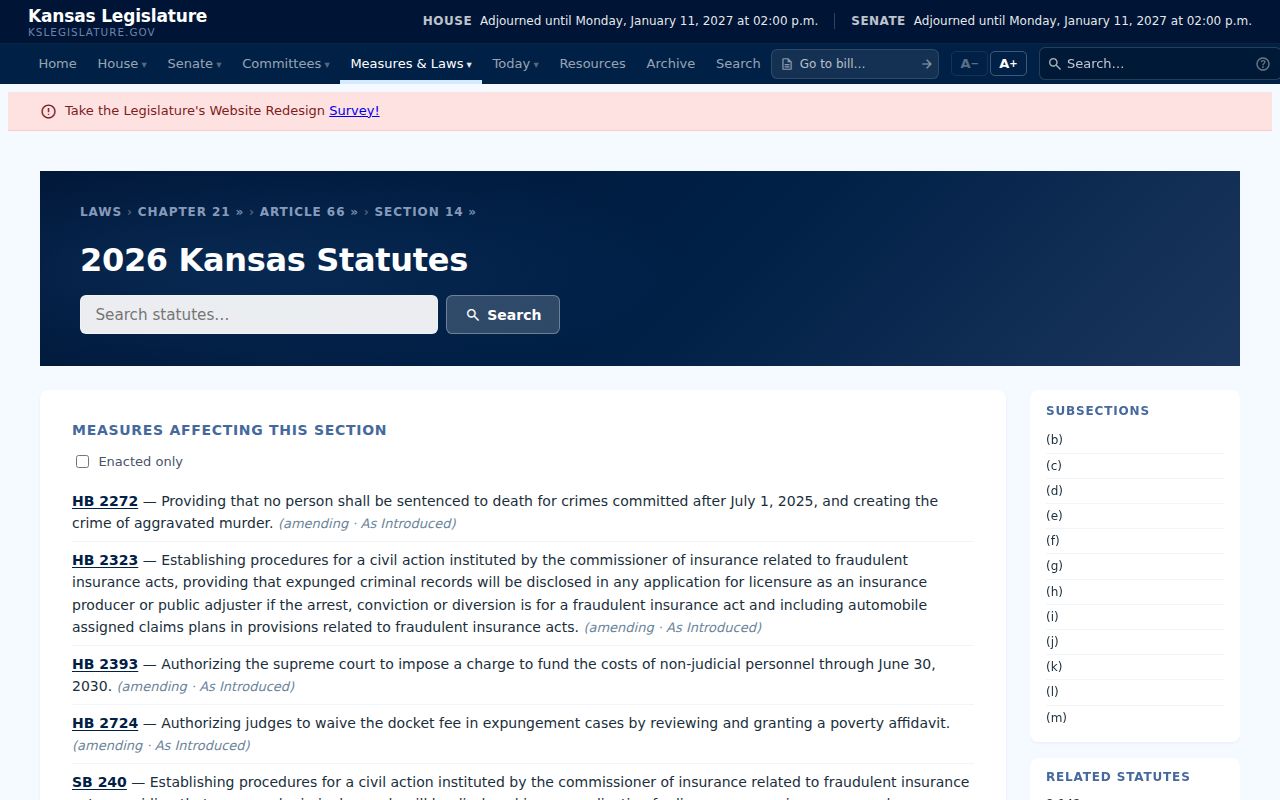
The statute governs the law itself, not any single Jefferson County case. Before assuming a docket is sealed, double-check the court and the case number. Typos and portal outages hide records that are fully public. A records request, however broad, cannot unseal a sealed file. The courthouse terminal simply will not display nonpublic material.
Keep in mind that one protected document does not erase the rest. Public case information may still exist for the asking. Name the exact hearing, order, or judgment you want. The clerk can then pull that item and apply any lawful redaction.
A courthouse terminal offers another way to view eligible Jefferson County criminal docket information that the web portal lacks. It cannot open a sealed file. Written requests work best when they name the court, the case number, the event date, and the specific document you need. The district clerk may send you to a municipal clerk when the issuing city owns the record. Call ahead if you are unsure who holds the file, and ask for the current cost estimate whenever you want a paper, electronic, or certified copy.
Older Jefferson County records, converted from paper, may be public yet absent from the web. That fallback chain matters. It keeps a portal gap from being mistaken for a legal outcome on the court docket.