
How to Get Court Records
Begin with Kansas CaseSearch. It can surface eligible Jefferson County case information plus a case number. Any document with a public link can be opened there. When the portal does not show what you need, the courthouse terminal is next. You can also call the District Court Clerk directly. A written request works too, using the Kansas court-record request form. Mail goes to the published post-office box once the clerk confirms the fee and format. The office fax is another documented channel. Acceptance and payment instructions should be confirmed first. The court offers no stable public email and no district-court drop box.
- Identify district, municipal, appellate, or federal court.
- Find the full case number and exact document name.
- Check online access and Kansas Supreme Court Rule 22.
- Call 785-863-2461 for custodian, fee, and delivery terms.
- Submit the precise request by the accepted route.
- Pay after receiving the current estimate and instructions.
Name the county, the full case number, the document type, the date range, and how you want delivery. You are asking for an existing record. The clerk will not draft a new report or give legal analysis.
Jefferson County Custodian Split
The Jefferson County District Court sits in the county courthouse. It is a state judicial office. Katie Chaney, Clerk of the District Court, keeps its case and event records. Jefferson County Clerk Julie Dunkle handles administrative, election, and tax-roll work. She does not hold the state trial docket. City ordinance and municipal traffic files stay with each city's municipal clerk. Federal matters run through the U.S. District Court for the District of Kansas.
This split sends plenty of requests to the wrong desk. The county's Open Records information points district-court questions to court administration. If an office says another agency holds the record, copy the court name printed on the case document. Then send the request to that custodian.
Types of Court Records
A Jefferson County court record might be a short events index or a filed order. What is public depends on the case type, the document type, the age of the file, any court order, and Rule 22. One caution applies. A portal entry does not guarantee that the linked pleading or exhibit is public online.
- Appearance docket or chronological events index
- Public complaints, petitions, answers, and motions
- Orders, judgments, and disposition documents
- Eligible criminal, civil, family, probate, and mental-health filings
- Plain copies, certified copies, and public terminal printouts
- Transcripts and exhibits through their separate access routes
A transcript is a verbatim record of a proceeding, prepared through an authorized reporter or transcription channel. Do not confuse it with a docket, a judgment, or an ordinary clerk copy.
Kansas Request Form Details
The official Kansas form asks you to pick a recipient: the Supreme Court, the Court of Appeals, a county district court, or another office. Then it collects your name, mailing address, city, state, ZIP, telephone, fax, email, delivery choice, a description, commercial-use certification, signature, and date. Delivery can run by email, mail, pickup, or fax. The Jefferson County office receiving the request still decides what is workable for that record.
Write a useful request: Identify Jefferson County, the full case number, exact filing or order, relevant date, and whether a plain or certified copy is needed.
The form quotes no Jefferson County fee, promises no production date, and links no local payment page. Its custodian block does allow an estimated reproduction cost.
What a Court Record Contains
A full Jefferson County case file may hold far more than the public search result shows. Kansas law requires the district clerk's appearance docket to record a brief case description plus the chronological papers, orders, verdicts, and judgments. Contents still vary. Everything depends on what was filed and what is public.
| Case Header | Court, county, number, type, filed date, status, and judicial officer. |
|---|---|
| Parties and Counsel | Names, roles, and attorneys of record when public. |
| Pleadings | Complaint, petition, answer, motion, or other filed paper. |
| Events Index | Chronological filings, hearings, orders, and dispositions. |
| Orders and Judgments | Signed rulings and final or interim decisions. |
| Documents and Exhibits | Eligible public items, subject to sealing, redaction, and access rules. |
A browser PDF is not automatically certified; certification is a separate act by the custodian.
Older Jefferson County Files
The court's eCourt conversion date shapes what is available. Case information may appear online while older documents remain at the courthouse. When a public filing seems missing, try the terminal. Or ask the clerk to locate the exact item. A blank document link does not mean the filing never existed. The district records guidance explains where the online boundary falls. The clerk posts no Jefferson County retention schedule, microfilm page, bulk subscription, or guaranteed archive turnaround. Rule 22 does not require a custom bulk distribution.
Certified Copies and Fees
A plain copy just reproduces an eligible record. A certified copy carries the clerk's authentication for official use. An exemplified copy, a transcript, an exhibit, and an electronic download are each separate products. Tell the Jefferson County clerk why you need the copy. Ask which form fits that need. No local price list or payment-method list is published. Never borrow another county's per-page or certification charge.
| Product | Jefferson County Route | Fee Status |
|---|---|---|
| Docket printout | Portal or courthouse terminal | Ask whether a print charge applies. |
| Plain document | Portal, terminal, or clerk request | Confirm page, electronic, and postage costs. |
| Certified copy | District Court Clerk | Current certification fee not published. |
| Transcript | Court reporter or approved transcriber | Separate fee and timing. |
| Restricted record | Authorized process or court order | Not released by an ordinary public request. |
Jefferson County District Court Clerk
300 Jefferson St., second floor
P.O. Box 327, Oskaloosa, KS 66066
Monday-Friday, 8:00 a.m.-4:00 p.m.
785-863-2461
Fax: 785-863-2369
Jefferson County Clerk Profile
Katie Chaney's office is the local contact for Jefferson County state district court records. The published clerk listing lists the direct phone and courthouse location, which makes it the best source for current copy availability, payment instructions, and the right submission channel. Court staff can locate records and explain access steps. They cannot give legal advice or build a new report from unrelated files. The official District Court clerk listing shows the contact details for this office.
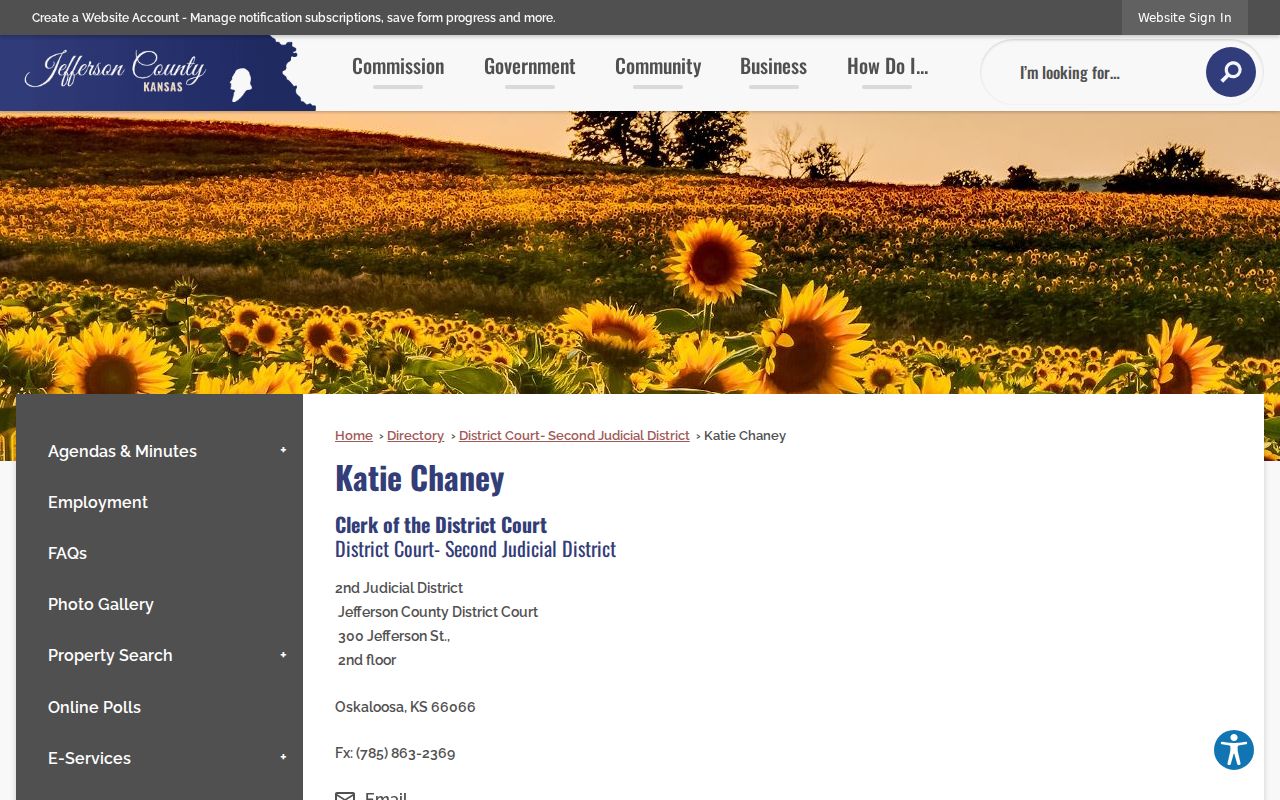
It ties the records request to the state court office, not the separate Jefferson County Clerk.
Jefferson County Request Timing
K.S.A. 45-218 sets out how quickly an office must answer. It also covers what to do when a request lands with the wrong office. For county agencies, the county page describes a three-business-day framework. The office must hand over the records, say when they will arrive, or explain why they cannot be released. District Court is different. It is a state judicial office with its own court rules. So treat it separately from county agencies.
Three business days is not a promise. A full court file may not get copied that fast. Old files sit in storage. Redaction review, fee estimates, transcript routing, and questions about who holds the file can each add time. So keep your own paper trail. Save the request you sent. Note the submission date, any fee estimate, and whatever the office sends back.
Public Access and Sealed Records
What you can see in Jefferson County court records depends on Kansas law, court rules, and sealing orders. A standard open-records request will not break a seal. Under Rule 22, files may be closed for adoption, juvenile, care-and-treatment, expunged, grand-jury, certain family and protection matters, and protected documents. Even open court records can have details blacked out. That includes account numbers, protected minor data, or other identifiers.
Key Rules:
Kansas Supreme Court Rule 22 governs public portal and terminal access and lists exclusions.
K.S.A. 45-218 covers inspection requests and proper-custodian direction.
K.S.A. 60-2617 addresses sealing, unsealing, and redaction by lawful process.
If you are an authorized party chasing a restricted file, the path runs through the applicable court process. No amount of public searching or broad KORA requests will turn protected content into a public record.